When Blak Excellence Becomes Blak Labour
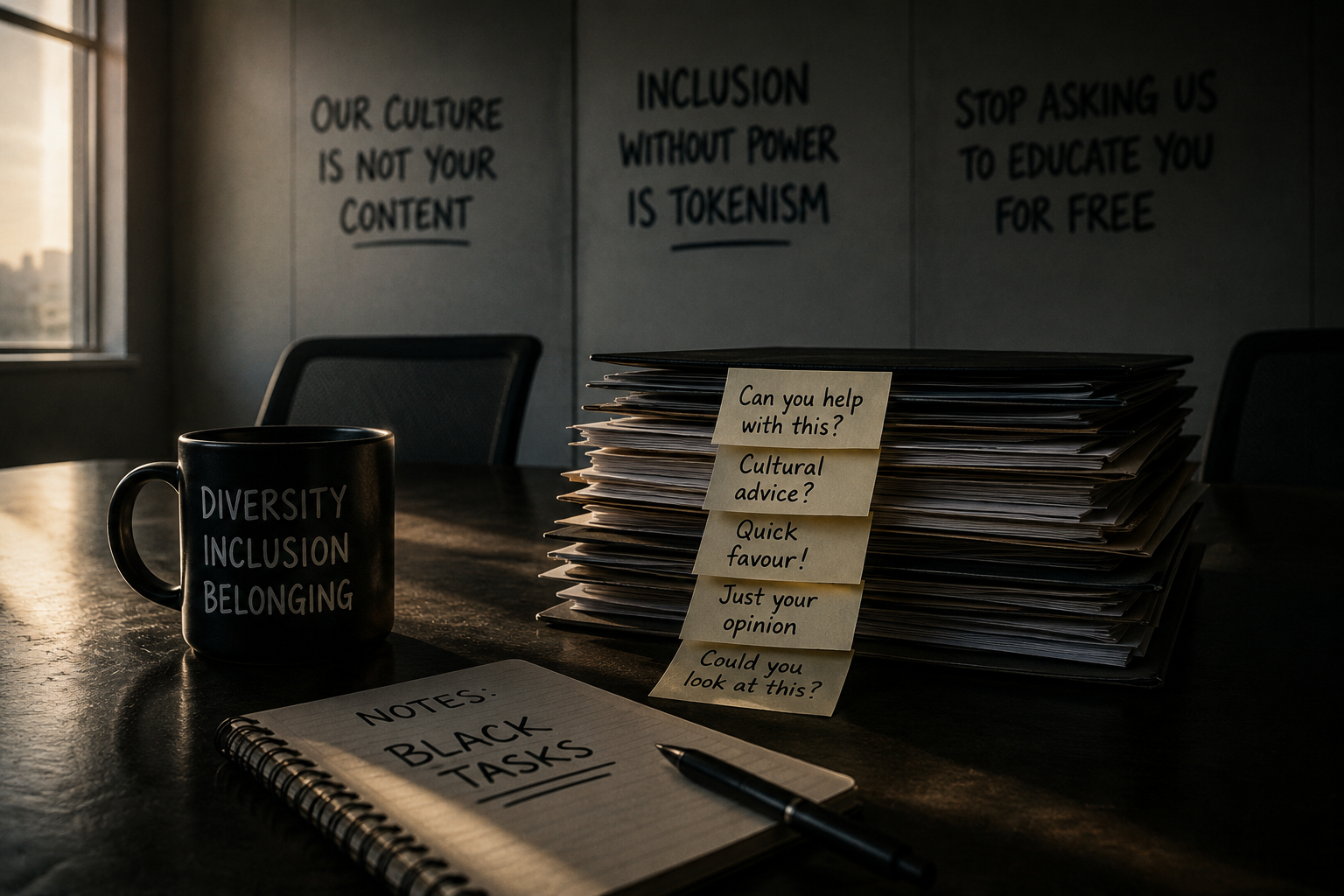
“Blak excellence deserves more than being pulled into the same old pattern with softer words and better branding.”
There is a particular kind of exhaustion that comes from being the Blak person in the workplace.
Not the normal tired where you need a coffee, a nap, or a weekend where nobody asks you anything.
I mean the deep tired.
The spiritual tired.
The tired that sits in your shoulders when someone sends you a message that starts with, “Hey, could you just have a look at this?”
And somehow, you already know what is coming.
Could you check this Acknowledgement of Country?
Could you speak at this event?
Could you sit on this panel?
Could you tell us if this artwork is appropriate?
Could you review this RAP action?
Could you help us with this First Nations thing?
Could you come and make this space feel safe, cultural and meaningful, even though nobody asked you what safety, culture or meaning actually requires?
And the wildest part is, they often think they are doing something good.
They think they are including us.
They think they are engaging us.
They think they are giving us visibility.
Meanwhile, we are sitting there thinking, here we go again.
Another Blak bullshit task dressed up as reconciliation.
Another cultural request with no resourcing.
Another emotional invoice nobody plans to pay.
Another moment where our identity becomes useful to the organisation, but our expertise is still somehow optional.
That is tokenism.
And it is not always loud.
Sometimes tokenism does not walk into the room waving a flag and announcing itself.
Sometimes it comes through a calendar invite.
Sometimes it is hidden inside a “quick favour”.
Sometimes it arrives with warm language, good intentions and a deadline that somehow becomes your problem.
Sometimes it sounds like, “We thought of you straight away.”
And yes, of course you did.
Because when the workplace wants culture, it suddenly remembers who we are.
When it wants truth, it wants it softened.
When it wants credibility, it wants our face.
When it wants reconciliation, it wants our story.
When it wants to look like it is doing the work, it asks us to carry the work.
But when we ask for role clarity, remuneration, authority, governance, strategy, decision making, workload recognition or actual power, suddenly everyone gets quiet.
That silence is loud too.
Because Blak excellence sees through it.
We see the pattern early because we have lived it too many times.
We know when an organisation is genuinely trying to shift power and when it is trying to decorate the same old table with a little bit of culture.
We know the difference between being respected and being used.
We know the difference between consultation and extraction.
We know the difference between a workplace wanting change and a workplace wanting a Blak person nearby so they can say change is happening.
And that is where the colonial load comes in.
Colonial load is not just being busy.
It is the extra cultural, emotional, intellectual and spiritual labour placed on Aboriginal and Torres Strait Islander people inside systems that were never built with us in mind.
It is having to explain racism gently so people do not feel attacked.
It is having to educate people who could have done the reading themselves.
It is being expected to speak for every mob, every community, every Nation, every family, every lived experience and every historical wound, while still meeting your normal KPIs.
It is being asked to make things culturally safe in a workplace where you may not even feel safe yourself.
It is being celebrated during Reconciliation Week, NAIDOC Week and Harmony Week, then ignored when you raise concerns about racism, workload, cultural governance or structural change.
It is being told your voice matters, but only when your voice makes the organisation look good.
And let me say this clearly.
Blak people are not workplace decorations.
We are not cultural garnish.
We are not the human version of dot painting on a corporate strategy.
We are not here to sprinkle a little bit of culture over a system that refuses to change.
We are leaders.
We are strategists.
We are knowledge holders.
We are professionals.
We are community connected.
We are trauma informed because life taught us to be.
We are systems thinkers because we have had to survive systems that were never designed for our survival.
We are Blak excellence.
And Blak excellence should not have to keep proving its value to people who only discover culture when the organisation needs a photo opportunity.
The hurt comes from knowing that so many of us want to contribute.
We do want workplaces to be better.
We do want people to learn.
We do want to open conversations.
We do want to help organisations walk softly, listen properly and do better.
But we are tired of being asked to carry the whole bridge while everyone else gets credit for crossing it.
We are tired of being invited into the room after the decision has already been made.
We are tired of being asked to endorse things we did not design.
We are tired of being handed reconciliation work as an “extra” when it is actually strategy, governance, risk, reputation, people, culture and leadership all wrapped into one.
We are tired of watching organisations spend money on consultants, reports, campaigns and morning teas, but hesitate when a Blak person asks to be paid properly for the cultural load they are already carrying.
Because here is the truth that makes people uncomfortable.
If an organisation benefits from our cultural knowledge, then that knowledge has value.
If an organisation uses our identity to build trust, then that identity has value.
If an organisation relies on our community connection, then that connection has value.
If an organisation asks us to help them avoid cultural harm, reputational damage or performative reconciliation, then that expertise has value.
And value should be recognised.
Not with a thank you email.
Not with a cupcake.
Not with a mention in a newsletter.
With authority.
With position descriptions.
With workload allocation.
With remuneration.
With decision making power.
With cultural governance.
With respect.
Tokenism asks us to be present.
Real change gives us power.
Tokenism asks us to tell our story.
Real change asks what systems need to shift so our people are not constantly harmed.
Tokenism brings us in for the photo.
Real change brings us in for the decision.
Tokenism wants culture at the event.
Real change embeds culture into governance.
Tokenism says, “Can you help us with this?”
Real change says, “What do you need, what will this cost, who needs to be accountable, and how do we make sure this does not sit on your shoulders alone?”
That is the difference.
And maybe that is why it hurts so much.
Because so often, we are not angry because we do not care.
We are angry because we care deeply and we are tired of watching care be exploited.
We are tired of watching organisations mistake our generosity for unlimited capacity.
We are tired of having our cultural responsibility used as a loophole for free labour.
We are tired of being expected to be grateful for inclusion when the inclusion still keeps power exactly where it has always been.
So when a Blak person says no, listen.
When a Blak person says they are tired, believe them.
When a Blak person says this is tokenistic, do not rush to defend the intention.
Sit with the impact.
Because good intentions do not erase colonial load.
A friendly email does not erase tokenism.
A Reconciliation Action Plan does not mean reconciliation is happening.
A workplace event does not mean cultural safety exists.
A leadership statement does not mean the organisation has shifted.
The real question is not whether your workplace has Blak people in the room.
The real question is whether those Blak people have power in the room.
Are they heard?
Are they resourced?
Are they protected?
Are they paid?
Are they believed?
Are they able to say no without being seen as difficult?
Are they able to challenge the organisation without being labelled aggressive, emotional or not a team player?
Are they being asked to do cultural work because they are the right person with the right expertise, or because the organisation does not want to invest in doing it properly?
That is the conversation workplaces need to have.
Not the glossy one.
Not the polished one.
The honest one.
Because Blak excellence is not here to make organisations feel good about doing the bare minimum.
Blak excellence deserves more than being pulled into the same old pattern with softer words and better branding.
We see it.
We feel it.
We name it.
And whether organisations are ready to admit it or not, we have always known the difference between being valued and being used.